David’s Path Thursday, Apr 14 2011 

1 Samuel
  • No organization, no family or no country can ever be great without great leadership. The  question is how do you get great leadership?
  • Israel faced that question after the time of the Judges seemed to fail the country.  The Philistines had migrated into the region about the same time as the Hebrews and had become a perpetual problem to Israel.
  • The Philistines continually pressured the nation of Israel for more territory and pushed their way into the mountains of Israel.
  • The Philistines had superior weapons and chariots. The Philistines appear to be less populous than Israel, but better organized.
  • Israel had no central government or regular army.  Israel was still a loose confederation of tribes that called on each other in times of crisis.  The nation had worked that way for several hundred years.  Change was needed but change is sometimes difficult.
  • Into this unfolding crisis, God gives us the book of Samuel.  Samuel is about three leaders.  Two of these leaders were truly great and took the nation to it’s zenith.  The third leader proved to eventually be an abject failure.
  • Surprisingly, the book opens with a family crisis.  This is really what Israel was facing as well, a family crisis, God’s family.
  • Two wives had a long standing bitter rivalry and quarrel.  Hannah, the barren wife turns to God in her desperate need, and God provides one of Israel’s all time greatest leaders. The result of her turning to God produces the man Samuel, after whom the book is named.
  • Samuel grew into one of the greatest leaders Israel was to know.  He served in four capacities.
  1. Prophet
  2. Judge
  3. Priest
  4. Military leader
  • Samuel chose the first two kings of Israel. His strong personality is the thread of the book of 1 Samuel even though he officially retires after chapter 15.
  • Samuel’s mother’s struggles are the struggles of Israel in miniature.  Her frustration forced her to look to God for an answer.
  • Her son did not follow his father into the field as a farmer, but he was raised in the temple to become God’s answer to Israel’s frustration with the nations around them.
  • Hannah’s story lets us know that leaders do not always come from regular channels. Ordinarily Eli’s corrupt sons would have carried on national leadership.
  • Instead, God blessed a woman who turned to him for help.  To me, this is the theme of the entire book of 1 Samuel.
  • Turning to God for instructions in every situation of life is the path to success.
  • Saul failed because he did not obey God and did not seek God.
  • David was magnificent.  Why?  There was only one reason.  David depended on God for everything and every decision.
  • In chapter 2, verse 30, God declares “Them that honour me I will Honour, and they that despise me shall be lightly esteemed”.
  • Samuel never forgot that lesson.  He anointed Saul as the first King, but stripped him of that position when Saul did not depend on God and obey God.
  • Samuel passed over more impressive men to anoint David because he sensed David would seek God and obey God.
  • Under David the nation achieves world greatness.  The only quality David had that Saul did not have, was his willingness to seek God and God’s direction.
  • David persistently turned to God for his direction.
  • The best leadership ultimately belongs to God!
  • It was God, not David, that took Israel from a disjointed, unorganized group of 12 tribes into the greatest nation on the face of the earth.
  • What do you want in life?  How do you achieve that goal?  May I recommend the path of David?
Learn the simple lesson that true leadership is simply following directions.

David followed God’s directions all the way to greatness.

And this my friends was David’s path to greatness.
Thanks for reading today.

400 Silent Years Thursday, Apr 7 2011 

400 silent years.

Interesting that the whole world was convulsing with worldwide change, yet Biblically it was silent.

While the world heard marching armies and battle cries, heaven was mute toward earth. It is called silent because there is no recorded instance of God speaking to man during this time.

When Malachi laid down his writing instrument, there was not a voice from God until the days of John the Baptist. When that stern Essene, John, lifted his voice for the first time to preach, 400 years of silence was shattered. How heaven must have rejoiced! God was again on speaking terms with His creation.

You are reading your Bible. You finish the Old Testament. You turn the page. You continue to read, not thinking of the vast time and change that happened in the turn of that page.

Because we are familiar with the New Testament, we do not stumble at terms like Pharisee, scribe or synagogue. But none of those or many other terms are used in the Old Testament. Were you not familiar with the Bible, you would indeed be scratching your head saying what is a Hasmonean? What is a Herodian? These and many other important Bible subjects and issues emerged during this silent period.

When the Old Testament closes, The Babylonian Empire has fallen and the Media Persian Empire has taken over. Cyrus the Persian has allowed the decree to rebuild the temple in Jerusalem. The Old Testament prophets have died, and there is a huge spiritual vacuum.

The writings of Daniel chart the course during these silent years and let Israel know all is on track as God predicted. Without Daniel, would they have been able to persevere? We do not know.

From the standpoint of world history, how do we measure the importance of the Greek Macedonian empire? The leader of Greece at this time was Alexander the Great. He is called “the Great” for some valid reasons. The cities the Greeks built, and the culture they exported to their conquered lands (Hellenism), was world changing. Romans built upon the foundation Greece had laid.

This period of Greece was followed by the Roman Empire which lasted 700 years and had two pax romanas (empire wide peace). Rome built the roads that missionaries would travel. Rome brought peace so missionaries could travel in relative safety. Yet all of Rome and Greece’s Hellenestic influence, is unmentioned or never referred to by God. Heaven’s record and evaluation appears to be far different than mortal men.

When Paul begins his missionary journeys that would transform the known world, these issues of Hellenism would play a major part. God placed these issues in the mosaic of time for all to be fulfilled when the fullness of time came to pass.

Cyrus the Persian was tolerant and allowed the repatriates to return to the land of Israel. According to Ezra only 42,000 or so elected to return. Babylon had been good to the Jewish merchants and life was plush. They had no desire to endure the rigors of the journey back to Palestine! Then after they arrived they would be required to live more primitive and frugal. The majority said “no thank you”.

Their needs had changed as a nation. Idolatry, that had been the albatross around the national neck for a thousand years, had finally been put away during the captivity. The death of idolatry, as strong as idolatry had been, was final. To this day none of us know of a single instance of a Jewish person who worships idols.

The Jewish people needed guidance. Into this vacuum stepped the scribe. Ezra was the forerunner of this elite group so highly esteemed. They were to play a vital role in Jesus’ day.

In captivity they had no temple to worship at, so the Synagogue was established. Any place ten Jewish males lived the Rabbi’s decreed a synagogue was to be built. The Rabbi was the local leader of the synagogue. Some Rabbis became famous and venerated among the population.

Here are some terms that play a part in the New Testament that are not in the Old Testament, but are there when you turn that page from Malachi to Matthew.

• Scribe (mentioned in Ezra)

• Synagogue

• Pharisee

• Sadducee

• Hasmonian

• Herodian

• Essene (non biblical term)

• Sanhedrin

• Governor (Roman)

• Tax collector

• Zealot

All of these are important in the inter-testament period. These are my definitions of them.
Scribe: became the leaders of the community. Interpreted the law for the common man.

Synagogue: House of worship for Jewish people all over the world. Visited every Sabbath.

Pharisee: Keepers of the law. Very concerned with detail. Jesus’ main opposition for three years. Not powerful in the government, for they could not get Jesus arrested.

Sadducee: wealthy group as a whole, many of them members of the Sanhedrin. Did not believe in the resurrection. When Jesus raised Lazarus from the dead and offended them, Jesus was arrested and put on trial.

Hasmonian: these were the Jews who wanted to merge with the Greeks and the Romans. They were ashamed of their Jewish heritage. They dressed like the Greeks and Romans. They even went so far as to reverse circumcision, so when they went nude in public like the Greeks, no one would know they were Jewish.

Herodians; these were a political group loyal to the Romans and the line of Herod who were puppet kings installed by Rome

Essenes: These were people who lived apart in communities like communes. They ate, dressed and lived very sparingly. John the Baptist was an example of an essene.

Sanhedrin: this was a Jewish council allowed by the Romans to adjudicate Jewish laws. Rome did not want to deal with the petty issues of a conquered nation’s differences. This group was comprised mostly of Sadducees, and consequently wealthy men. History says the number was 70 who were on this council. Maybe they chose the number from Moses’ day?

Governor; When Herod the great died he divided his kingdom into three parts. He gave one of the parts to Archalaus his son who was extremely vial. The night Archalaus inherited, he killed 3000 Jews to entertain his guests. Rome removed him for his cruelty and replaced him with a governor. There were several governors before the New Testament opens, but at Jesus’ trial the governor was named Pontius Pilate.

Tax collector: The Roman Empire lasted 700 years. American has lasted about 250 years. It is easy to see Rome was around a long time. Their success in part was due to how they adjudicated the subjugated peoples they conquered. As a rule they left the national laws and traditions in place and this contributed to their longevity as an empire. They followed this policy with Palestine. All Rome asked was the tax due the empire. So they leased out the collecting of taxes to the highest bidder. The tax collector kept whatever he could extort from the people. As a rule the tax collectors were despised as rouges and crooks. Matthew, Jesus’ disciple was a tax collector.

Zealot: maybe a more familiar term to us would be revolutionary. A zealot was a person who wanted to over throw the Roman power over Palestine. One of Jesus’ disciples was a zealot, lending credibility to the charges against Jesus that ultimately got Him crucified.

To the world at large the 400 years were not silent. It was business as usual. There was commerce and war, peace and revolution. There was the siren song of time marching steadily forward.

Finally after 400 years of heaven’s silence, in a far flung corner of the mighty Roman Empire, a child was born and a son was given. Heaven has never been silent since, and will never again hold it’s peace.

God was manifest!

Thanks for reading today

The Prophets Friday, Apr 1 2011 

The Prophets.


When Israel left Egypt on that fateful night of the Exodus, they were ill equipped to be a world member in the family of nations.  Their centuries of slavery had left them without the basic skills to form a nation and function.


They needed laws and leadership.  God provided them with both.


While they made the transition from slavery to a warrior nation to conquer the Promised Land, they needed something to anchor them to their past, to their beliefs and their survival.  God gave them the Tabernacle as that anchor.  It was the central element that polarized them as a people.  It was the central purpose and function of their lives.


The Tabernacle eventually became the Temple and the Temple stood as their foundation and polarization for centuries. It was the central point and purpose of their lives.


After their conquest and several hundred years of judges and monarchy, they had become an urban people with need of a different anchor.  The nation had not become, or remained what God had intended!  They needed another anchor for a different environment of urban life.


God sent them their second anchor…the Prophets!


The first prophets were miracle workers.  Elijah and Elisha types.  They got the attention of the Nation at locals like Carmel when Elijah confronted the prophets of Baal.


When it was evident that the miracles alone would not  turn the nation back to God, God then sent them a whole new group of men.  The writing prophets!


About 40 years after Elisha, the first writing prophet appears on the national scene.  God introduced the second anchor for the nation!  His word!


From the moment the writing prophets arrived, all of history changed.


These prophets were diverse.

  • Some were highborn, educated and mixed with the highest echelons of society.
  • They were consults of Kings!
  • They were advisors of the highest decisions made in the world.


Others were simple country men.  They were ridiculed and scorned.  Their verbiage and illustrations were simple and homespun.  They preached messages, wrote poems, composed songs, and condemned Kings.


They are without equal or comparison in any period of history or in any culture in the world.


The Eastern religions for all their lasting impact have never produced the likes of the writing prophets!


The Prophets wrote their visions and conversations with the Almighty.  They left behind a glimpse into the mind and nature of God that became the mantle of all preachers for all time.  We would not have survived without their writings.  Simple or complicated, rich or poor, heard or rejected, to a man….


They were magnificent!


Thanks for reading today!


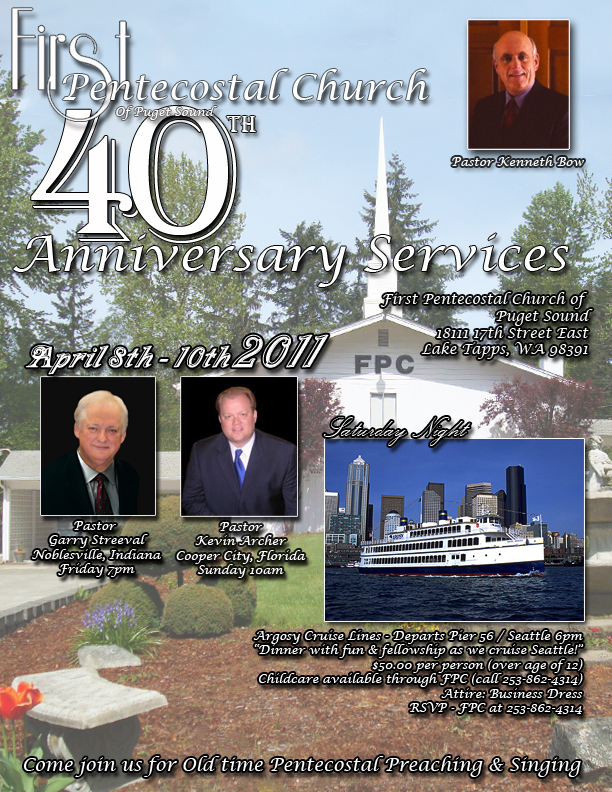
FPC 40th Anniversary Wednesday, Mar 30 2011 

And Now We Come To The Most Important Part Of The Service Tuesday, Mar 29 2011 

And Now We Come To The Most Important Part Of The Service

Over the last ten years as I have rambled over the United States, I have encountered a somewhat new viewpoint among some friends of mine.

Having great respect and affection for the friends I have, I sure want to be careful in disagreeing and taking the chance of losing those good friends.

Sometimes the issue is big enough and important enough, that you just can’t sidestep the issue in the name of friendship.

This is one of those times that friendship just can’t elbow out my loyalty to the right concept. I think I would like to speak up on this.

It has generally been friends that are involved in music ministry. They have made the comment to me that they disagree with ministers saying “Now we come to the most important part of the service”.

This of course refers to the preaching. These friends usually preface their comments with how important preaching is, and other comments, but they make it clear that other parts of the service are important also.

Most of the time they express that this is indeed somewhat old fashioned, and we have now matured to the place we recognize that many parts of the service can be, and are, just as important as preaching.

Well, I sure do admit that I am not a spring chicken, but I am not yet on social security either! I like to think I am somewhat current on music.

Our church took second place last year at a music fest at the fair grounds. Our little area of four million people in the Puget Sound has quite a few churches. I ain’t bragging, but neither am I taking the tuck head as a red neck, old geezer who is living in the fifties either.

So I think I will air out my perambulating thoughts about “Is the preaching the most important part of the service?” Here goes.

We take pride in basing our doctrine, our baptism, our spiritual experience in the book of Acts. We stick our chest out and say, hey, we go back to the book of Acts!

So let me challenge my music friends and dare them to show me just one example, just one incident in the entire New Testament where music was the factor or even a factor in New Testament conversion.

Now I love music, and we sing it loud and long at FPC. But fair is fair. Is it in the book of Acts or not? Hate to inform you but it is not there.
Acts 2, Acts 8, Acts 10, Acts 19, are all passages of conversion. The day of Pentecost, the Samaritans, the Gentiles, and the disciples of John the Baptist were all converted without music and with preaching.

My point being many were converted to full christianity with preaching and none were converted with music. No one has ever been converted without preaching!

Can I safely say that preaching is essential? Would I do better to say “We now come to the essential part of the service?” Would that make my music friends feel less agitated?

How about this? Hindus sing. Buddists sing. Muslims sing. Are they saved?

How bout this? All christians sing. Apostolics sing, trinitarians sing, charasmatics sing, in fact we sing many of the same songs. Are we all saved?

Jesus said in that day many will say, Lord Lord have we not….and He will say depart from me ye that work iniquity!

Is the difference between truth and error preaching or singing?

It is the preaching that sets true believers apart from false believers.

True believers and false believers sing many of the same songs, but they do not and never will preach the same doctrine!

It is preaching that separates the chaff from the wheat.

Another point. I can start, build, and pastor a church without music. I do not want to, and do not plan to, but it is possible. I cannot start, build, and pastor a church without preaching. So what really is the most important part of the service?

So forgive me for getting a little worked up. I am just a wee bit tired of hearing this statement. All of you are welcome and wanted at First Pentecostal Church of the Puget Sound. We would love to have you visit.

But just so you know, I will say during the service, “And now we come to the most important part of the service”. And I won’t be introducing the choir. It will be time to take the good book and preach the word of God.

Preaching is essential.

It is based in the book of Acts.

It separates the true believer from the false believer.

It is the most important part of the service.
Thanks for reading today.

– Posted using BlogPress from my iPad

I Will Not Ignore Uriah’s Religion Saturday, Feb 26 2011 

Abiathar was angry.  He was going to confront Uriah.  As the priest that David
trusted in he would not allow this Hittite to worship Baal in the camp.

He stormed up to the camp fire where the noted warriors were lounging.  The fire
flickered on the swarthy faces of these hodge podge freedom fighters.

When he walked up, silence invaded.  It always does when the preacher walks in.

With steel in his voice he challenged Uriah.  'Have you been worshipping your
God here in the camp of Israel?'

Funny how silence can suddenly freeze every sound. Uriah was slow to answer.  He
was not about to take anything from any man, but this was the priest.

How he answered could easily start major trouble with men who wore their swords
ready to hand.  He had seen bloodshed in a flash not long ago when Abner met
Joab.

His eyes were steady as he looked up at Abiathar.  Slowly he stood.  He looked
up to only one man.  The man he gave his allegiance to.  David.

He respected Abiathar, but he feared no man. While the elite fighters of David
waited to see how this would go down, he said, "actually no I have not".

He waited.  Abiathar was seething with a righteous vengeance. 

"What are the remains of the altar I found today?  The word is that you
worshipped your god of the Hittites there.  I demand an answer!" Abiathar half
shouted.

Other men gathered around.  The small fire was now surrounded by a legion of
David's fighting men.

Uriah said tersely, " You asked If I worshipped in the camp.  I did not.  I went
to a high place and there practiced my own beliefs."

Abiathar snarled "How dare you?"

Uriah stood his ground.  "I did not join David's religion.  I joined his cause
to fight for his Kingdom.  He has never spoken to me of my faith.  I have done
nothing wrong."

Abiathar's eyes were those of a zealot.  Smoldering, angry, barely contained,
eyes.

It was a standoff of proud men both who felt they were right.

It was Joab of all people who deescalated the moment.  

Slowly Joab rose to his feet.  All eyes shifted to the General.

Joab slowly and calmly said to the priest, "Uriah is not asking you to approve
of his worship Abiathar.  He is asking you to ignore his religion."

Everyone there could feel the release of tension.  It was a word fitly spoken. 

Abiathar stalked off into the night.  Uriah stretched his hands to the fire and
said nothing.

It is not the things that we are forced to approve that are our danger in 2011.  

It is the things we ignore.

Did Uriah's religion factor in to David's taking Bathsheba?

Why did Bathsheba have enormous influence on David until his death?

Did Joab resist placing Uriah in the forefront of battle? He was after all a
Baal worshipper?

I do not know these things, but I do know this......

The world is not asking me to approve of Gays.  The world is asking me to ignore
them. 

 Pulpit silence.  

The world is not asking me to approve of abortion.  The world is asking me to
ignore it.

Pulpit silence.

The world is not asking me to approve social drinking.  The world asks me to
ignore it.

Pulpit silence.

Maybe just maybe had Abitahar forced the issue, the entire course of Israel's
history might have been redirected.

I have decided I will not approve, nor will I ignore certain things.

I will speak, and maybe some Uriah's may yet live!

Thanks for reading today.

Acts of the Apostles Thursday, Feb 24 2011 

Acts

Oft times I have wondered about certain books of the Bible.  I have thought, what if we did not have this book in our Bible?  How would that affect the whole?  When I place the book of Acts on that pedestal, and consider, I am certain of the answer.

Only Acts and Genesis seem to hold the place of absolute.  Without them we simply could not survive.  They are both irreplaceable.

The book of Acts was written by Luke.  Luke is the only Gentile writer in the Bible.  It is interesting to me that Luke is responsible for 25% of the New Testament.  His two books equal one fourth of the volume of the New Testament.

I am not positive, but it appears to me that Luke wrote at the bequest of a wealthy patron named Theopholis.  His two books address this individual.  This was a common practice that carried well into the middle ages.  A wealthy patron would sponsor someone to write a book or thesis. This is how men like Voltaire and Rousseau were supported financially.

To me, Acts is about three men.  Those men are Simon (Peter), Saul (Paul), and Stephen. The book is evenly devoted to the ministry of Peter and Paul with Stephen being the bridge from one to the other.

The contrast of these two men is stark.  Peter is a country fisherman.  Paul is a polished cosmopolitan.  Peter was ignorant and unlearned.  Paul was a trained rabbi, having studied at the feet of Gamaliel. Peter spoke Aramaic, the common language.  Paul could speak that language, as well as Greek.  Peter was a country Jew, Paul was a Hellenistic Jew and a Roman Citizen.

The first twelve chapters of Acts are about Peter.  In chapter 13 the spotlight shifts to Paul and never moves back to Peter again.  Peter, the great apostle fades from view in Acts.

How important is Acts as a book?  It is irreplaceable! Without the book of Acts we would go from the Gospels to Romans.  We would wonder who is Paul?  What is the church?  How did it start?  Acts is the link to all of the New Testament.

Acts begins with the ascension of Jesus.  It moves on to choosing Judas’ replacement. It then tells of Pentecost, the beginning of the church, and eventually documents the church’s emigration to the Roman Empire.

Christianity conquered the Roman Empire, period.  The Roman Empire paved roads, established peace and continuity, and through this open door walked the church.  The church flourished during the Pax Romana, the empire wide peace. Within 300 years 10% of the Roman Empire was Christian.

The book of Acts documents the beginning of this conquest of the church.

When the spotlight shifts to Paul in chapter 13, Luke begins to relate Paul’ missionary journeys.  Paul made three journeys.  ( Some scholars say up to five).  The dates of these journeys are:

  • 46-48, first journey
  • 49-52, second journey
  • 53-57, third journey

It is simply amazing that in 47AD there were no churches in Asia Minor.  In ten years there was a ring of churches that included every major city in Galatia, Macedonia, Asia and Acacia.  This remarkable achievement has never been repeated anywhere globally.

On his first journey, when he gains his first convert, the Apostle Paul jettisons his Hebrew name Saul, and forever becomes know as Paul.  He was the Apostle to the Gentiles and he bore his Gentile name to his death.

Luke is a gentile, writing a book about the gentile revival by the Apostle to the gentiles.  This fact shows up in the book repeatedly.  It is very clear in the story of the appointment of the deacons.  When the division came and the controversy showed itself, out of the seven men chosen, 5 were Greeks according to their names.  Luke makes this point, or rather the Holy Ghost does.

The final chapters of the book of Acts are concerning Paul’s last days.  I am left with one of the biggest questions of my life as to why the book ends so inconclusively.  With the Holy Ghost inspiring the man called Luke, why no closure?

My only hypothesis is that the book is still being written in heaven.  Maybe the final words were something like “to be continued”.

What chapter will you write to add to the book of Acts?

Romans Wednesday, Feb 23 2011 

Paul was 51 years old.

Working with his hands making tents lent time to ponder and muse. His brilliant mind was filled with the wonder of his Lord.

His thoughts wandered around the world while his body remained at Corinth where he was in the midst of the greatest move of God he had yet to witness.

It had been a near fatality.

He had arrived on the brink of despair.

Then the simple decision to preach just Jesus and nothing else had exploded the city of Corinth.

The conversion of many high officials, as well as thousands of ordinary people, had kept his mind occupied for almost a year and a half. No one had ever seen anything like the revival in Corinth.

Today his mind had dreamed of something akin to this happening in Rome. From that epicenter his precious gospel could truly turn the world upside down.

It had begun with a conversation with Sister Phebe.

She commented she was going to Rome. Instantly Paul had pleaded with her to take a greeting from himself to the saints there in the center of the empire.

Laying aside his tools, he picked up his writing instrument and began….

Paul a servant of Jesus Christ…..to all that be in Rome…..

The letter to the Romans. The book that offers the grand view of the Gospel.

The overview of the majesty of God’s plan to man. Sweeping vistas, mountain peaks, and unparalleled heights of revelation.

In Romans Paul unveils God’s plan, man’s depravity, and the ultimate solution to sin.

He scales the ramparts of Jew and Gentile relationship. He plumbs the depth of the death, burial and resurrection.

He laughs at the Law’s ineffectual conclusion and exalts grace as man’s only hope.

What began as a greeting to a far off fraternity of believers, becomes the grand work of the Gospel to the world.

When Phebe stopped by to pick up the greeting Paul had asked her to deliver, she held in her hands the greatest masterpiece of God’s purpose to His creation.

She carried on that ship the summation of 4000 years of law and it’s failure.

She carried Heaven’s solution to Eden’s tragedy.

In about ten to fifteen years Paul would finally catch up with his letter. When he arrived in Rome many years later, he would discover his letter had been received and circulated.

He arrived a prisoner of Jesus Christ, for no mere Caesar could imprison an Apostle.

It was there in Rome, where his mind had gone ten years before, while working on a tent during the Corinthian Revival, that his incredible life came to an end.

He ended his life in a prison.

The irony is the prison was the place he had desired to send others when Jesus called to him on the Damascus Road some 30 plus years ago.

But the dream of the Corinthian Revival also happening in Rome, and ultimately the Roman world, was unfolding.

In the next three hundred years, ten percent of the Roman Empire became Christian.

The gospel to the Romans became the Gospel to the world, watered with the blood of the man who dreamed it could be!

Thanks for reading today!

The consequence of anger 500 years later Tuesday, Feb 22 2011 

I read Martyn Ballestero’s blogs as do hundreds of people every day. While reading the recent posts on anger I thought of a Bible incident that sheds light on anger.

It involved the tribe of Simeon. Simeon and Levi had committed and act that angered and disappointed their aged father.

In their mind they were defending their sister Dinah, but their method was cruel and hateful. It appears that their father thought they were angry when they acted.

In Genesis 49, Jacob, now Israel, passes the patriarchal blessing on to his twelve sons. When he gets to Simeon in verse 6, he says, “cursed be their anger, for it was fierce; and their wrath, for it was cruel: I will divide them in Jacob, and scatter them in Israel.”

This was their judgment for their actions in killing the men of the Hivites.

This prophecy comes true over 500 years later when the tribes receive their inheritance. When Simeon is allocated his land it is a portion that is surrounded by Judah. It is the only tribe so done this way. It fulfilled the prophecy Simeon was to be divided in Jacob.

In Joshua chapter 19, the lot for Judah is too large, so it is subdivided so the smaller tribe of Simeon is given a portion of Judah.

The consequences of anger still lingered 500 years later. God surrounded it with praise to keep it from further damage and devastation to the other people of God.

Anger is destructive and it’s consequences last for a very long time.

Thanks for reading today!

John Sunday, Feb 20 2011 

John

John was Jesus’ first cousin and His best friend for 3 ½ years. Jesus’ mother and John’s mother were sisters. No man on earth knew the story of Jesus better than John. His gospel is a magnificent treatise to the life of Christ and it’s impact on planet earth.

His gospel is different than the others. Very different! It is written like John is sitting under a shade tree with his feet propped up, just daydreaming about the life of Jesus. He only selects vignettes, short insights or events, from 20 days in the life of Christ.

John uses the simplest words, and a small vocabulary to plunge us into the deepest mysteries of God. John uses the vocabulary of a six year old child. A child learns about 100 words a year and John uses about 600 words in his writing.

The words John selects are powerful words. He uses words like world, father, light, and truth. He uses the simplest words to paint a profound God and His plan.

Matthew writes to the Jew, so he begins his gospel at the lineage of Abraham. Luke writes to the gentile Roman world, so his lineage begins at Adam. John writes to the church, so he reaches all the way back to eternity. He begins with, “In the beginning”.

.John reaches back to the inky blackness of eternity, before there was the brush of an angel’s wing. He reaches back before there was the first blazing shaft of light that shattered the darkness. When there was nothing but God. In the beginning was the logos, the word, the thought, the intent. And the logos was God.

John does not cover the same material as the other three gospels do. The only miracle he repeats is the feeding of the 5000. He writes to the church about 60 years after the other writers. The church was facing many challenges.

When John wrote, there were those who said Jesus never really existed. There were others saying Jesus was not a human, but rather a phantom. Other views at that time proclaimed Jesus did exist but he was just a man with divinity projected upon him by his disciples. It was into this morass that John wrote his gospel.

John writes of no parables, and uses 7 signs to build his story of Jesus. He explains things like no other writer. When he tells a miracle, he often explains why he used that miracle. An example would be the feeding of the 5000. He tells us Jesus is the bread of life. The other three writers did not explain the connection for us. When Jesus heals the blind man, John explains Jesus is the light of the world. It is his explanations that give his gospel an added dimension.

He also includes things of immense importance. Consider how important John chapter three is to the doctrine of the new birth. The story of Nicodemas is the bedrock of salvation. Ye must be born again. That one inclusion validates the day of Pentecost and the doctrine of the New Testament church. Chapter by chapter, John gives the church a gospel for the ages. He delivers the most profound insight into Jesus the man, of any writer of history.

2/3 of John’s book is about the last week of Jesus’ life. Fully 1/3 of his book is about the last 24 hours of Jesus’ earthly life. After 60 years, the need was for a complete record of the importance of calvary. A whole generation had arrived that were not eye witnesses to the events of Jesus’ death. Someone needed to write it down and John succeeded as Heaven’s emissary.

We have the gospel of John and it is indeed magnificent!

« Previous PageNext Page »