I Will Remember Thursday, May 28 2026 

“I Will Remember”

Text: Psalm 77:10–11 (KJV)

“And I said, This is my infirmity: but I will remember the years of the right hand of the most High.
I will remember the works of the LORD: surely I will remember thy wonders of old.”

Introduction

Psalm 77 is not written from a mountain top.
It is written from a valley.

The writer is troubled.
His spirit is overwhelmed.
Sleep has left him.
Questions are filling his mind.

He begins by talking about his pain…
but then something changes.

He says:

“This is my infirmity: BUT I will remember…”

There comes a moment when a child of God must stop staring at the darkness and start remembering the faithfulness of God.

The devil loves spiritual amnesia.
He wants you to forget:

  • the prayers God answered,
  • the doors God opened,
  • the miracles God performed,
  • the times God carried you.

But Asaph said:
“I may be hurting… but I still remember.”

Suddenly the psalmist saw the years, all of them, even the years of tragedy and loss, as being at the right hand of the Most High Himself. The name Elyon itself is significant for it was the very name of God to which Melchiz-edek introduced Abraham—”the Most High God, possessor of heaven and earth!”

The years of the right hand of the MOST HIGH.” Our thoughts go back to the Bethlehem road, to that dark spot in Jacob’s pilgrimage, near Bethlehem, about two miles south of Jerusalem and a mile north of Bethlehem. Jacob had been steadily moving south from Bethel—acting again in self-will, for God had told him to go to Bethel and dwell there. On the way, near Bethlehem, Rachel insisted on a halt. There was a birth and a death right there. Benjamin was born; Rachel died. The journey had been too great for her. Oh, that they had stayed at Bethel! There, by the wayside, Rachel brought that little boy to the birth, weeping in her birth pains and in her death throes. “Call him Benoni,” she gasped as her spirit fled. Brokenhearted, bereft of his very heart, Jacob took the little fellow in his arms. “Not Benoni,” he said, “but Benjamin.” “Not ’son of my sorrow,’ but ’son of my right hand.’” It was a glorious moment of faith triumphing over feeling.

The psalmist looks up into the face of the Most High. He thinks of the years—the years with their long tale of wickedness and woe, the years with their mysteries and miseries. “I will not write ’Benoni’ over those years,” he says. “I will write ’Benjamin’ over them.” They are the years of the right hand of God.

Dustin Bresina testimony

Tiffany Hettinga testimony

1. Remembering Is a Weapon Against Despair

The Psalmist said:

“This is my infirmity…”

“Infirmity” means weakness, affliction, limitation.

He admits:
“I’m struggling.”
“I’m weary.”
“My emotions are wounded.”

Even great people of faith have weak moments.

  • Elijah sat under a juniper tree.
  • Job cursed the day of his birth.
  • Jeremiah said he was weary with forbearing.
  • Peter wept bitterly.

But the turning point came when the Psalmist shifted his focus.

He stopped looking inward…
and started looking backward.

Sometimes the greatest thing you can do is revisit the victories God already gave you.

The devil says:
“God has abandoned you.”

But memory says:
“No He hasn’t.
He made a way before.”

Illustration

It is amazing how quickly fear can erase memory.

Israel walked through the Red Sea…
then a few days later said:
“Can God furnish a table in the wilderness?”

How could people who saw water stand up like walls suddenly doubt Him?

Because fear attacks memory.

That is why testimony matters.
That is why worship matters.
That is why we tell our children what God has done.

2. Remember “The Years of the Right Hand of the Most High”

The “right hand” in scripture speaks of:

  • power,
  • authority,
  • victory,
  • favor.

Asaph was saying:
“I remember the years when God’s hand was upon me.”

There are seasons in your life where you can clearly see:
“That was the hand of God.”

  • You should have lost your mind…
    but God kept you.
  • You should not have survived…
    but God brought you through.
  • You did not know how you would pay the bill/rent/car payment…
    but somehow provision came.
  • The doctor gave one report…but God gave another.

You are sitting here today because of the right hand of God.

Scripture

“Thy right hand, O LORD, is become glorious in power…” — Exodus 15:6

God’s hand is still mighty.

The same hand that:

  • parted seas,
  • shut lions’ mouths,
  • raised the dead,
  • filled the upper room—

is still working today.

3. Remember the Works of the Lord

David said:

“I will remember the works of the LORD…”

Not coincidence.
Not luck.
Not accident.

The WORKS of the Lord.

When you look back over your life, you can see fingerprints of God everywhere.

There were moments:

  • you didn’t even know He was protecting you,
  • you didn’t know why a door closed,
  • you didn’t know why a delay happened—

but later you realized:
“God was working all along.”

Sometimes We Forget Too Quickly… can I get an amen

We pray for miracles…
then once the storm passes, we move on as if it was ordinary.

But the Psalmist said:
“I will remember.”

Remember:

  • where He found you,
  • what He delivered you from,
  • how He filled you with the Holy Ghost,
  • the prayers He answered,
  • the revivals He sent,
  • the times His presence swept through the church.

4. Remember the Wonders of Old

“Surely I will remember thy wonders of old.”

“Wonders” speaks of miraculous acts that leave people amazed.

The church must never lose its memory of the supernatural.

We are serving:

  • the God of Pentecost,
  • the God of miracles,
  • the God who still heals,
  • the God who still delivers,
  • the God who still fills people with the Holy Ghost.

If He did it before…
He can do it again.

Illustration

David faced Goliath with old memories.

He said:
“The God who delivered me from the lion and the bear…”

Yesterday’s victories became fuel for today’s battle.

Some of you need to walk into your next battle carrying remembrance.

Tell the devil:

  • “God healed me before.”
  • “God made a way before.”
  • “God touched my family before.”
  • “God brought revival before.”

And if He did it then—
He can do it now.

5. Memory Produces Faith

Remembering is not living in the past.
Remembering builds faith for the future.

When you remember what God HAS done…
you gain confidence in what God WILL do.

The God of yesterday is still the God of today.

Scripture

“Jesus Christ the same yesterday, and to day, and for ever.” — Hebrews 13:8

God has never failed.
Not once.

Kings have failed.
Governments have failed.
Economies have failed.
People have failed.

But God has never failed His people.

Conclusion

The Psalm began in sorrow…
but remembrance shifted the atmosphere.

Sometimes the answer is not a new revelation.
Sometimes the answer is remembering old ones.

Asaph essentially said:
“I refuse to let pain erase my testimony.”

Closing Exhortation

Remember:

  • the altar where God changed you,
  • the night He filled you with His Spirit,
  • the sermon that broke your heart,
  • the miracle that saved your family,
  • the times He protected you,
  • the prayers He answered.

You didn’t get here by yourself.

It was the goodness of God.
It was the mercy of God.
It was the mighty hand of God.

Altar Call

Before you ask God for the next miracle…
take a moment and remember the last one.

Before you pray about what you lack…
thank Him for what He has already done.

Somebody ought to lift their hands and say:
“Lord, I remember.”

“I remember Your mercy.”
“I remember Your power.”
“I remember Your faithfulness.”
“I remember the wonders of old.”

A mature believer learns to talk back to present trouble with past testimony:

  • “God brought me through before.”
  • “He healed before.”
  • “He provided before.”
  • “He made a way before.”
  • “The same God who opened the sea is still with me now.”

Current trouble is real, but it is not the whole story. The memory of God’s faithfulness becomes an anchor for the next storm.

And the same God who worked then…
is about to work again.

Mornings Thursday, Jan 22 2026 

Morning

Here are some passages that teach about seeking God early in the morning:

1. Psalm 63:1 David in the wilderness

“O God, thou art my God; early will I seek thee: my soul thirsteth for thee, my flesh longeth for thee in a dry and thirsty land, where no water is.”

This is the classic verse:

  • Early will I seek thee
  • Not obligation — desire and hunger

2. Proverbs 8:17

“I love them that love me; and those that seek me early shall find me.”

God attaches a promise to early seeking:

  • Seek early → find God

3. Lamentations 3:22–23

“It is of the LORD’S mercies that we are not consumed… They are new every morning: great is thy faithfulness.”

Morning is when:

  • Mercy is renewed
  • Yesterday’s failures don’t define today

4. Mark 1:35 Jesus’ example

“And in the morning, rising up a great while before day, he went out, and departed into a solitary place, and there prayed.”

How do we go wrong if we follow Jesus example?

Jesus:

  • Woke up before sunrise
  • Sought God before people

5. Psalm 5:3

“My voice shalt thou hear in the morning, O LORD; in the morning will I direct my prayer unto thee, and will look up.”

6. Isaiah 50:4

“He wakeneth morning by morning, he wakeneth mine ear to hear as the learned.”

Morning is when:

  • God teaches
  • God speaks

7. Job 1:5 Job as priest for his family

“And Job rose up early in the morning… and offered burnt offerings.”

Job didn’t wait for crisis:

  • He covered his family daily
  • Early intercession

8. Psalm 88:13

“But unto thee have I cried, O LORD; and in the morning shall my prayer prevent thee.”

“Prevent”  means:

  • Go before
  • Start the day with God first
  • Give God the first and best

We believe in first fruits, and that if we give God the first of our finances, he will bless the other 90%.

What about our day? Is it possible…

“If God gets your first hour, He’ll bless your remaining 23.”

“The devil wants your mornings rushed, distracted, and noisy — because he knows whoever controls your morning often controls your day.”

“Those who seek God early don’t just start the day better — they start the day aligned with eternity.”

  • First light
  • First love
  • First voice you listen to
  • First spirit you yield to

All of Scripture leans toward this principle:

Seek Him first — especially in the morning.

El-Shaddai Monday, Jan 19 2026 

El-Shaddai

El: the God who can do anything

Shad: correlates to chest or breast (similar) to a mother nourishing her child at her breast

Is there any feeling like when your child comes and crawls up in your lap and lays their head on your chest and just lays there? No words. Sometimes there are just sobs and sniffles. Maybe I’m just a sentimental old fool but to me there’s no feeling like that in the world you don’t even have words to discribe it or explain it. 

You softly murmur it’s OK baby mama‘s got you -OK honey OK daddy‘s got you. I wonder if El-Shaddai holds us to his breast and whispers it’s OK I got you. Everything‘s gonna be all right.

You hold them to your breast and something is transferred between the two of you that is truly unspeakable. There’s a transfusion of love and peace and grace that is non-judgmental: that moment rights the wrongs. It makes the world a better place again. Their whole life is right side up again. 

That little part of you laying on your breast, that came of out of your flesh, snuggles and hides his face in your breast…their world is right again.

That’s what El-Shaddai does. When you leave that moment of being held to his breast, the one who can do anything, your world is right again.

Problems are still there, you’re still without a husband, you’re still broke, you still have the disease, but somehow, those things are now in the background. Your strength is renewed. You leave that moment strong enough to face life again: you have been in the presence of El-Shaddai and he has held you against his breast.

The Tower of Edar Wednesday, Jan 7 2026 

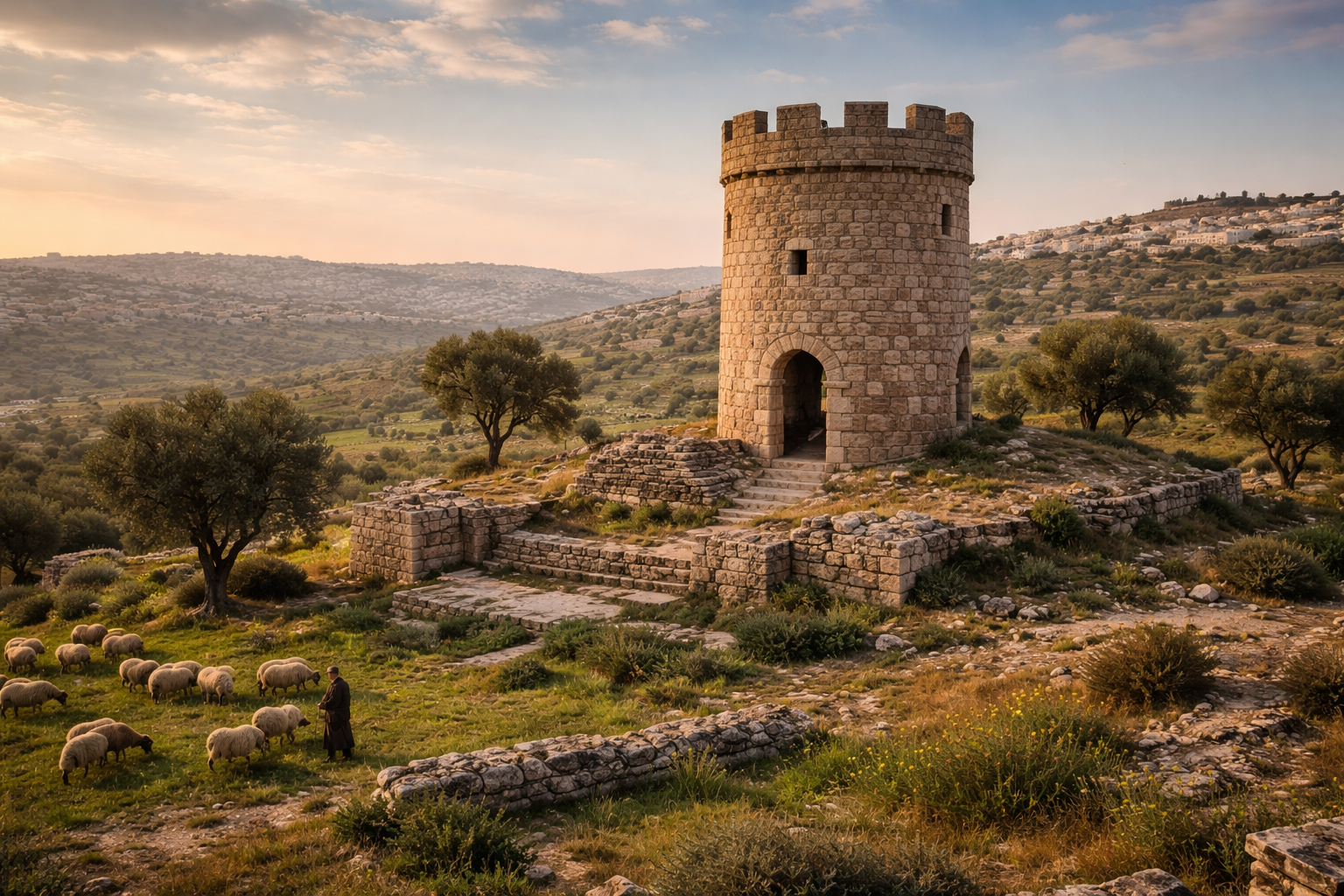
Reading today…. Rachel dies….buried on the road that they will take to captivity and then return many years in the future. Jer 31.15-17. Jacob travels 1 mile and stops at the tower of Edar. 

The Tower of Edar (also called Migdal Eder, meaning “Tower of the Flock”) is located very close to Bethlehem.

Distance

• Approximately 1 mile (1.5–2 km) from Bethlehem

• Roughly a 20–30 minute walk

• Just outside Bethlehem, traditionally toward the south or southeast, near the shepherds’ fields

Biblical Context

• Mentioned in Genesis 35:21 (KJV)

“And Israel journeyed, and spread his tent beyond the tower of Edar.”

• Jewish tradition (notably Micah 4:8) associates Migdal Eder with Messianic expectation

• Many Christian scholars connect this area with the shepherds of Luke 2, making it significant in Nativity studies

Why this matters

Migdal Eder was understood as a watchtower used by shepherds—particularly those raising lambs for Temple sacrifice. Its close proximity to Bethlehem strengthens the theological symbolism of Christ’s birth near the place where sacrificial lambs were watched and protected.

I thought it was interesting that Jesus was born in the place where sacrificial lambs were raised for temple sacrifice. He was the lamb of God and he was born in the spot where they raised lambs for that purpose. (Note: the photo is an AI creation, not an actual photo).

Our Mandate: Daily Study Tuesday, Dec 30 2025 

The mandate to read and study the word of God each day and make it a daily part of our life is not found in the Torah (the first five books of the Bible). It is found in Joshua chapter 1.8. The blessings and the conquest of personal territory written in the book of Deuteronomy chapter 11 happens when we apply the admission of Joshua one and eight to our life, our work, and our free time.

Deuteronomy 11.8 Therefore shall ye keep all the commandments which I command you this day, that ye may be strong, and go in and possess the land, whither ye go to possess it; 

9 And that ye may prolong your days in the land, which the LORD sware unto your fathers to give unto them and to their seed, a land that floweth with milk and honey.

10 For the land, whither thou goest in to possess it, is not as the land of Egypt, from whence ye came out, where thou sowedst thy seed, and wateredst it with thy foot, as a garden of herbs: 

11 But the land, whither ye go to possess it, is a land of hills and valleys, and drinketh water of the rain of heaven: 

12 A land which the LORD thy God careth for: the eyes of the LORD thy God are always upon it, from the beginning of the year even unto the end of the year.

13 And it shall come to pass, if ye shall hearken diligently unto my commandments which I command you this day, to love the LORD your God, and to serve him with all your heart and with all your soul, 

14 That I will give you the rain of your land in his due season, the first rain and the latter rain, that thou mayest gather in thy corn, and thy wine, and thine oil. 

15 And I will send grass in thy fields for thy cattle, that thou mayest eat and be full.

Joshua 1.3 Every place that the sole of your foot shall tread upon, that have I given unto you, as I said unto Moses. 

4 From the wilderness and this Lebanon even unto the great river, the river Euphrates, all the land of the Hittites, and unto the great sea toward the going down of the sun, shall be your coast. 

5 There shall not any man be able to stand before thee all the days of thy life: as I was with Moses, so I will be with thee: I will not fail thee, nor forsake thee. 

6 Be strong and of a good courage: for unto this people shalt thou divide for an inheritance the land, which I sware unto their fathers to give them. 

7 Only be thou strong and very courageous, that thou mayest observe to do according to all the law, which Moses my servant commanded thee: turn not from it to the right hand or to the left, that thou mayest prosper whithersoever thou goest. 

8 This book of the law shall not depart out of thy mouth; but thou shalt meditate therein day and night, that thou mayest observe to do according to all that is written therein: for then thou shalt make thy way prosperous, and then thou shalt have good success.

We must also be careful that our work does not affect our daily study of Scripture. The addiction of becoming lazy or a workaholic and not making Bible study a priority can also lead one into temptations and sin that can violate our personal relationship with God as well as our fellow human beings. The goal is to achieve a healthy balance between our study of God’s word and our daily work.

Anavah-humility Monday, Dec 22 2025 

Anavah-humility.

Have you ever been just out for a walk or maybe in nature somewhere and all of a sudden you were overcome with the awe and the wonder of all you were seeing around you. Walking through the forest, walking along the beach, watching children play on a playground. These breath taking moments can cause you to stand in awe and realize how small we are in the big scope of the world.

In the Hebrew language, the word we translate humility is the word anavah. It is a very interesting word to our English way of thinking. The literal definition is to occupy your God given space in the world. This has a meaning of don’t overestimate yourself and how important you are, but on the other hand, don’t underestimate yourself as though you have no significance at all.

Early in the Bible, there’s the story of the people who wanted to build a tower. They wanted to make a name for themselves. It would appear from that statement that they wanted to be famous. They wanted people to know who they were. They wanted to do something that everyone would admire and respect. When you look at it carefully, their desire was to do the exact opposite of what the word anavah-humility means in the original language. They wanted to take up more space than their God-given allotted-space in the world.

In today’s world so much of this generation is about liking our Facebook post. It’s about retweeting our friend’s post so they can get more views. Many times this creates a false sense of self-worth and how important we are. We are following in the footsteps of the tower of Babel, trying to take up more than our God-given space in the world.

It is my belief that when we try to take up more than our God-given space, it brings discontent in our life. This is not anavah, humility.

Some people are of the opinion that humility is thinking less of yourself. That idea translates into taking up as little space on this earth as possible. It would mean staying out of people’s thinking and off their radar. This is not a correct posture. This is not what God wants of us. God wants us to be aware of our place and to be comfortable in it. When we do this we balance our lives and live in peace and contentment.

There is a very beautiful balance in learning this principle of anavah. When we do this and only take up our space two things happen. 

Number one we do not squeeze anybody else out of their space and compete for their space. 

Number two we don’t reduce our space so that we don’t take care of our responsibilities and others have to help us with our lives because of inferior feelings, self hatred or weakness.

I encourage you keep in mind anavah

Make a choice today: I’m going to take up the space that God gave me to fill. I’m not going to intrude on someone else and try to take up their space. I’m not going to hide from the world and shrink out of everyone’s focus -and thus force someone else to do what I should be doing.

Anavah is understood as properly “occupying your God‑given space,”- neither inflating yourself nor denying genuine gifts.

It includes empathy and responsiveness to others’ needs, seeing one’s abilities as responsibilities entrusted by God rather than grounds for arrogance.

Anavah is modesty in your stance before God and other people.

Stand your ground-but only your ground. 

(Resources: 52 Hebrew words by Dave Adamson and Perplexity AI)

Which study Bible in 2026? Thursday, Dec 18 2025 

 Which study Bible for 2026?

One of the most common questions I have been asked over the last 50 years in my travels is simply which is the best study Bible?

I think all of us know there is no singular answer that encompasses everything.

Some Bibles excel in readability like large print. Some Bibles appeal because of their size and ease of carry. I am of the opinion some Bibles are carried in our modern world because they are currently a fad. You know it’s the groovy Bible to carry. It is the latest… Have you got one yet? There are even some Bibles that would carry a certain status with some people. Maybe it’s a collectible. Maybe it’s a new bind in an exotic leather of some type. I really do understand all that, and that is not even my subject today. My subject today is totally trying to focus on the content and what it would add to your knowledge in the next 365 days of 2026.

Every year at this time I spend a little time deciding which study Bible I’m going to use for the next 12 months. This is a simple process that I have used for the last 30 years or so. I have used many study Bibles. Here are a few that I have used. I began with the Thompson Chain Bible. I have also used the Schofield Bible, the Dake Bible, the Companion Bible, the Spirit Application Bible, the Ryrie Study Bible, the Chronological Bible, the Student Bible, the Hebrew Bible, the Apostolic Study Bible, and of course, the Premier Study Bible. There have been others that I have used, but I think you get the picture.

I have read the Bible every year cover to cover since I was 14 years old. The majority of those years has been a different study Bible. I do my best to read not only the Bible text, but the footnotes, the introductions, and all the added information.

When Young ministers ask me what I would recommend them to read I always recommend use a different study Bible every year and read everything. That includes the dates, the notes, the references, all of it. It is my personal opinion this is one way a young preacher can “round out” a lot of his thinking on doctrinal issues and also biblical history.

I would like to tell the young impatient ministers there are no shortcuts to really understanding the Bible. It is a long, lifetime process. There is no one study Bible that’s going to make you brilliant and smart by itself alone. I believe most older advanced ministers would tell you that the more they’ve studied the more they realize what they don’t know.

I would like to add a personal recommendation. If you only read or study so that you can preach a message you’re going to miss the greatest moments in your spiritual life. I believe your study should be because you love Jesus Christ. 

I believe your study should be daily. If you truly study daily, you will never be without a message to preach. You will always have more subjects than you can deliver in public services. Learn to be consistent, learn to put the word of God first, and God will give you sermons and revelations.

Having said that let’s begin. I am not going to include the Premier Study Bible (PSB) in this blog. My reason is, I have spent a number of years participating writing commentary and in the development of this Bible. I am still on the publishing board and the financial board of the PBS. It is impossible for me to be impartial and to not prefer it above the others —so please know that what I’m about to write does not include the PSB. Every young beginning minister should start his ministry by reading the PSB cover to cover.

I realize this next comment will cross swords with a number of preachers, and I am fine if you disagree. I have never read any translation, except the King James version of the Bible. It is my preferred reading and study. I have used other translations to see if there is a meaning in a particular passage that I am overlooking, however, to be honest I’m 99% always using the KJV. I believe in the majority text and I believe it is the correct text to study. This whole subject is maybe for another blog. Suffice it to say that I am not a believer in the minority text and the Bibles that are printed from that textus. This also applies to even the interlinear. It is impossible to remove 60,000 words from the text without affecting what you’re studying.

So today the question I am discussing is: if you could only have one study Bible, which one would it be?

My answer (that excludes the PSB) is if I could only have one Bible, I would want to use the Thompson Chain. It is possible that some of my bias is because it was the first Bible I began to use when I started preaching full-time at 23 years old. I still have it, and it literally has been written on every single page of the Bible. I believe in writing and making notes in my Bible -that is just a personal preference.

The original Thompson Chain-Reference Bible company was purchased in the last few years by Zondervan. They have produced it in a new binding and a new block text. This is a very good Bible. It is a Bible that if you did not own any other reference material, you would still be able to get a very well-rounded picture of doctrine and Bible history. It is literally the Bible on itself -meaning what does the Bible say about the Bible, and it leads you through chains of scriptures to do that.There is no one “Bible wonder” that does everything, but I do think this particular Bible comes closer than the others.

Just for fun I’m going to list some Bibles and what I prefer about these particular Bibles:

For reading: Schuyler (I like the chapter divisions)

For carry to church: Allan ( I like red letter and Allan does not make any)

For size/convience: Cambridge (my first Bible bought with my own money at 16)

For article/cool notes/introductions: The Student Bible (Zondervan-out of print)

For new preppie cool factor: Humble Lamb

For being a collectible: Thomas Nelson Signature Series (out of print)

Whatever Bible you choose to use in 2026 may I highly recommend reading your Bible cover to cover in 2026.

Blessings

Reflecting on 50 years of Ministry Saturday, Dec 6 2025 

Reflections on 50 years of preaching and modern preaching.

One half of a century: In some ways it seems a blink of an eye, in other ways it seems like a bite of eternity.

50 years ago I was 23 and today I am 73. At the end of last July, 2025 I reached 49 years of full time ministry. At the end of July 2026 I will complete 50 years of full time ministry. So much has changed and much has remained the same. 

My focus today is ministry and preaching. Concerning preaching I am referencing style, content, and delivery. These are my somewhat random thoughts.

Recently, over the last few years I have noticed in myself I prefer slower, quieter preaching. I kind of drifted into that without planning or even recognizing it was happening.

It seems to me I gradually began to see this in myself and began to analyze my thoughts. I found myself being disloyal to the loud fast preaching and decided to not allow negative thoughts to influence me in the years that remain in my life. I had found myself grimacing when the screaming got loud. As lame as it may sound I sincerely began to seek God for what He thought as opposed to what I was experiencing.

I may be misreading this next part as to what happened to me, but I see the poetic justice God uses at times in what happened. 

I had been given a small book on Hebrew words as a birthday gift by a dear lady in our church. I have been reading it slowly and carefully. While in the mindset of considering modern preaching it seems God straightened out my thinking.

There is a small Hebrew word TAL. It is the word for dew, morning dew. The small book ignited my thinking on how God speaks to us. This book emphasizes how the dew is so important in scripture. It is used 37 times if I have counted correctly. It is always used in terms of blessing.

As I pondered this I realized God has two major ways to send the water to earth that earth must have to survive. God uses dew and rain.

There are two ways the Word of God comes:

The dew – gentle, quiet, soaking over time -this is teaching.

The rain – loud, powerful, saturating fast – this is preaching.

Both are heavenly.

Both are divine.

Both are needed.

But they are not the same.

THE DEW OF TEACHING: SLOW, CONSISTENT, NOURISHING

The dew falls silently in the night when no one hears it.

It doesn’t shout.

It doesn’t announce itself.

It simply appears.

I will be as the dew unto Israel…

Hosea 14:5

Dew is personal.

Dew is delicate.

Dew doesn’t run off – it soaks in.

Teaching is the dew of heaven.

It comes quietly into the spirit,

line upon line,

precept upon precept.

For precept must be upon precept… line upon line… here a little, and there a little.

Isaiah 28:10

This is teaching:

where the pastor calmly

opens the Scriptures,

and expounds the Word,

and truth sinks gently into the soul.

Pentecostals love the shout 

but we also need the stillness of instruction.

For the dew of teaching forms roots.

THE RAIN OF PREACHING IS SUDDEN, POWERFUL, AND REVIVING.

Now look again at the text:

My doctrine shall drop as the rain…

 Deuteronomy 32:2

Rain is bold.

Rain is public.

Rain makes a noise on the rooftops.

Rain gets everyone’s attention.

This is preaching.

The voice lifts.

The anointing strikes.

The Word thunders like Elijah on Mount Carmel:

there is a sound of abundance of rain.

1 Kings 18:41

When preaching falls,

chains break,

altars fill,

sinners weep,

and backsliders tremble.

Rain produces shout,

but dew produces depth.

Rain revives quickly,

but dew sustains quietly.

THE CHURCH NEEDS BOTH THE DEW AND THE RAIN

Some churches only get dew 

and the saints grow knowledgeable but grow dry in passion.

Some churches only get rain 

and the saints shout but lack foundation.

Their spirituality only lasts a few days.

But God intended both.

In my search I discovered there is no place on planet earth where dew is not found. In some arid locations it is the only form of hydration for plants, hence a desert. Dew is quiet but causes nourishment daily. None of it is lost. It slowly works its purpose without any waste or runoff. The Bible uses dew as a metaphor for blessing. 

Rain is more noticeable. Rain can be gentle or intense. Rain can bless or cause destruction by flooding with cloud bursts. Rain can be forecast by weathermen. All rain is not salvaged. We must have drains and gutters and French drains due to overflow. Rain was used as a form of judgment in the days of Noah’s ark. Rain has more forms and intensity. Rain is loud and obvious. 

As I pondered this I began to feel like God was chiding me and correcting me. It was clear from a Bible perspective both are needed to give life giving water to our earth.

My conclusion is we need both dew (teaching) and rain (preaching). 

When I began to travel as a young evangelist I was 23 and only knew how my pastor did things. Brother Terry, my pastor, was a strong teacher.  Our general church life was we would have a long revival of six weeks or so and then Brother Terry would teach and establish the new converts. He also preached at times but in my memory he taught more often.

It seems to me this was the case with many churches in the 1960-1970 era. The large churches of those decades were built by men of teaching and preaching (dew and rain). Men like Paul Price, the Davis brothers, David Gray (used charts at times), Voar Shoemake, Clyde Haney, and others. 

I say this to encourage young preachers. Preach it hard and loud and long. 

Bring the rain!

Those of us who have many miles on our odometer can also take confidence in the value of the dew (teaching). The manna was attached to the dew so never doubt the value of teaching.

Numbers 11.9

9 And when the dew fell upon the camp in the night, the manna fell upon it.

In Simple Terms

If an environment is very dry or very stable in temperature, dew will not form. 

Jesus said I would that you were either hot or cold.

Just as there are places on earth where dew is rare, there are hearts where the spirit’s moisture no longer settles. 

Dryness comes when prayer ceases, when the air of faith grows thin. 

But just as Elijah prayed and the heavens gave both rain and dew again,  revival always begins when someone kneels and calls upon the Lord.

So let us not become deserts.  

Don’t let your faith become dry in the heat of distraction.  

Let the dew return – the quiet Word that roots us.  

Let the rain fall – the power that renews us.

When the dew rests upon our spirit, truth takes hold.  

When the rain pours from heaven, the fruit appears.  

And when both move together: teaching and preaching, Word and Spirit — the Church becomes a flourishing field under open heavens.

Lord, make us a people who receive Your dew in the dawn and Your rain in the storm that Your Word may live in us,  

and through us, the earth may be refreshed again.

False Teachers Thursday, Dec 4 2025 

False teachers by Kenneth Bow

They stand in garments shining, yet their hearts are full of night;

They speak with swelling words of praise, but never walk in light.

They promise fountains flowing, yet their wells are dry within;

They cause the hurt of Zion, but they never call it sin.

With smooth and crafted speeches they deceive the simple soul;

They bind with cords of flattery, yet never make men whole.

They love the chiefest places, and the greeting in the street;

But tremble not before the Lord, nor bow at Mercy’s seat.

They flee when wolves are coming, for they never knew the Lamb;

Their staff is but a painted rod, their cry a hollow sham.

They steal the words of others, saying, “Thus the Lord hath said,”

While God stands far from their deceit and truth falls cold and dead.

But still the Good Shepherd rises, and His voice the sheep will hear;

His rod corrects, His staff protects, His presence calms their fear.

For every false anointed, there is One who reigns above—

The Shepherd true, whose only crown was truth, sacrifice and love.

So test the spirits daily, weigh each voice against His Word;

For many feign the prophet’s fire, yet do not obey the Lord

Cling to the ancient pathway, let His truth defend your way—

The Lamb will guard His chosen flock until His coming day.

The Overton Window Friday, Nov 21 2025 

The Overton Window

 “When the Window Moves, but the Word Stands”

Understanding Culture, Conviction, and the Overton Window

TEXT:

Psalm 119:89“For ever, O LORD, thy word is settled in heaven.”

Jeremiah 6:16“Ask for the old paths, where is the good way, and walk therein…”

Romans 12:2“Be not conformed to this world…”

INTRODUCTION

The world around us is shifting. Culture is changing. Values are drifting. Things that were once unthinkable have become normal.

Not because truth changed…

but because the cultural window moved.

Sociologists call it the Overton Window—the range of ideas that society sees as acceptable at any given time.

But the church doesn’t live by a window.

The Overton Window moves through stages:

We live by the Word.

When the Overton window moves, but the Word stands.

“The world is always shifting its standards.”

1. Unthinkable

2. Radical

3. Acceptable

4. Sensible

5. Popular

6. Policy

What was once shocking becomes normalized.

What was once sin becomes celebrated.

What was once holy becomes mocked.

But don’t mistake social acceptance for spiritual righteousness.

Isaiah 5:20

“Woe unto them that call evil good, and good evil…”

Culture moves.

Trends move.

Beliefs move.

But God says, “I change not.” (Malachi 3:6)

II. THE CHURCH MUST RECOGNIZE THE DIFFERENCE BETWEEN CULTURE AND DOCTRINE

Culture can shift. Doctrine cannot.

Some things are cultural:

• Music styles

• Service length

• Technology

• Dress fashions

• Architecture

• Program formats

The window moves on these things. That’s normal. It’s fine.

But some things are biblical, eternal, unchanging:

• Holiness

• Repentance

• The Oneness of God

• Jesus’ name baptism

• Infill­ing of the Holy Ghost

• Separation from the world

• Righteous living

• Moral purity

• Apostolic worship

These do not move with the window.

They are fixed by the Word.

We do not let culture determine our convictions.

We let Scripture determine our stance.

III. WHEN THE WINDOW MOVES, THE CHURCH MUST STAND IN THE OLD PATHS

Jeremiah 6:16 tells us to seek “the old paths.”

Not old clothes.

Not old songs.

Not old traditions for tradition’s sake.

But the old paths of truth:

• The Gospel

• Prayer

• Consecration

• Worship

• Holiness

• Apostolic identity

Those paths never go out of style.

Culture may shift, but conviction must stand.

When the world says, “Loosen up,”

the church says, “Hold the line.”

When society says, “It’s not a big deal anymore,”

the church says, “If God said it, it is still a big deal.”

When the window moves,

the Word stays where it’s always been.

IV. THE DANGER OF A MOVING WINDOW: DRIFT

Hebrews 2:1 warns us:

“…lest at any time we should let them slip.”

If you aren’t anchored, you drift.

If you don’t hold the line, the line moves.

If you don’t know the Word, you follow the window.

**Samson didn’t lose his strength in one moment—

he lost it in stages.**

Step by step…

Compromise by compromise…

As the window moved in his life,

his conviction weakened.

**Lot didn’t jump to Sodom—

he inched toward it, step by step.**

He moved his tent “toward Sodom,”

and eventually he was living in the city.

Culture pulls.

The enemy pushes.

The window shifts.

If we are not anchored, we drift.

V. WHEN THE WINDOW MOVES, THE CHURCH HAS A CHOICE

Choice 1 — Follow culture.

This leads to compromise, confusion, and coldness.

Choice 2 — Follow Christ.

This leads to revival, authority, and anointing.

You cannot keep both:

• The favor of the world

• And the fire of the Spirit

You choose one.

VI. THE CHURCH CAN SHIFT CULTURE WITHOUT LETTING CULTURE SHIFT THE CHURCH

The Overton Window does not just move us

the church can move it.

Every revival moves the window of what people think is possible.

In Acts:

• They prayed until the Spirit fell.

• They preached until hearts were pricked.

• They worshiped until jail doors opened.

• They lived holy until the city took notice.

Revival moved the window.

If the church will:

• Pray boldly

• Worship passionately

• Preach truthfully

• Love deeply

• Live holy

• Stand firm

…we will shift the culture around us.

VII. THE CALL: FIX YOUR LIFE TO THE WORD, NOT THE WINDOW

Ask yourself:

“What has moved in me that God never told me to move?”

“What have I accepted just because society accepted it?”

“What convictions have softened?”

“What disciplines have drifted?”

“What holiness line have I allowed to shift?”

It’s time to:

• Rebuild the altar

• Return to prayer

• Reclaim holiness

• Rededicate ourselves

• Realign with the Word

• Reject cultural compromise

• Re-anchor our identity in Jesus

CONCLUSION

Culture has a window.

The church has a Word.

Culture shifts.

Truth stands.

Trends come and go.

Holiness does not.

The world changes its mind every decade.

God’s Word has not changed in eternity.

Stand with the Word.

Live above the window.

Anchor your life to the truth.

And let God use you to shift the culture around you.

Next Page »