Thousands of children murdered! Thursday, Dec 16 2010 

Jerusalem Gazette: Thousands of children murdered!

The Gazette has learned through informed sources that before dawn today soldiers of Herod’s army began the massacre of thousands of small children. The murders have been literally from house to house. All the children killed are young, in fact none have been over two years old.

In attempting to find out what is behind this unprecedented horror, we have asked Herod to make a statement. At ten this morning Herod’s press secretary read a statement from the King.

It stated that recently there had been a formal request to see the King from a group of Magi. These wise men had journeyed from the east for approximately 18 months in search of the King of the Jews.

Their claim was that they were astrologers and were following a star that reportedly was to lead them to the King of the Jews. Herod took them serious. There were about forty Magi in the group, the normal number that travel in these troupes. The Magi claimed they had gifts of Gold, Frankincense and Myrrh.

Herod complimented the Magi and requested when they found the new King, that they inform him so he also could go and worship him.

An unidentified source informed us that Herod was livid. After the magi left he went into a tirade. No one would take his Kingdom from him that he had spent years developing in conjunction with Rome. He was the rightful King of the Jews! He had Caesar’s guarantee!

Our source also informs us there was a heated family argument on how to handle this recent threat to the Herod’s throne. Antipas, Philip, and Herodias all put forth different ideas. After long and acrimonious debate, it seems Archalaeus won out. It was he who put forth the simple solution.

Well, he said slowly, there is one sure way to rid us of this threat. All eyes centered on Archalaeus, he took a deep breath and said, just slay all the male children under two years old. Our sources say it was as if the air left the room. The enormity of the idea was nauseating. Even the ruthless Herod clan was speechless. All eyes were on the floor. For many minutes no one said anything.

Herod stood and left the room.

Before dawn today the soldiers of Herod began the massacre that is to eliminate any future King of the Jews.

Our latest news states somewhere around ten thousand young children have been murdered.

– Posted using BlogPress from my iPad

Guess who’s coming to town? Thursday, Dec 9 2010 

Guess who’s coming to town?

Well let me give you some hints!

He wears Red.

His hair is white.

He arrives in the middle of the night.

He knows if you’ve been good or bad.

He lives in the north.

He let’s children sit on his lap.

He sits on a throne.

When he laughs he says…Ho, ho!

Yep, you got it…..

His name is…….

*

*

*

*

*

*

*

*

*

*

*

Jesus!

He wears a scarlet robe,

His hair is white as wool,

He is coming as a thief in the night,

He knows all things,

He lives on the sides of the north,

He welcomes the children,

He sits on a throne,

Zechariah says he laughs….Ho, ho!

Just don’t forget who is really coming to town!

Thanks for reading today.

Abraham’s nephew…..Job! Monday, Nov 15 2010 

Abraham’s nephew.

No I am not speaking of Lot. I am actually speaking of Job.

As best as I can research, Job was the son of Abraham’s brother Nahor.

This would make Job and Lot first cousins. What a contrast!

Lot leaves with the man of greatest faith in history and still struggles in Sodom.

God leaves Job in Uz without any support from Uncle Abraham and Job leaves behind a “memorial” to a life of faith to rival that of his Uncle Abraham!

The story is familiar to most of us. There is the introduction with a cosmic contest beyond the human senses.

God and Satan discuss Job without Job’s knowledge.

God says I bet you can’t and Satan says I bet I can.

Satan was wrong. He is always wrong. A classic bimbo and loser. Who would follow such an idiot with a track record of repeated stupidity?

After the first failure Satan slinks back into the throne chamber and says Ya-but.

God smiles and says okay, but I still bet you can’t and Satan says I can.

Mr Stupid tries again and guess who was right again? Yep. God was again right and Mr Stupid Satan is wrong again.

Let me introduce you to Job’s friends.

Eliphaz: a descendant of Esau, an Edomite. Gold digger, money lover and idiot like his ancestor.

Bildad: Abraham’s brother’s son’s son so another cousin. Classic family troublemaker. We all have them. False accusers, arrogant “better than you”, cousins who stink up the place.

Zophar: A flaky friend whose name means to “leave early”. With wit only the Almighty could dream up, he calls the flake who leaves early Zophar! He only goes Zophar (so far), then flakes out.

Finally after three rounds in which Zophar flakes out on the last round because he only goes so far, there enters another character on the stage.

Elihu: This is Job’s younger brother. Trace the names and they both have the same father. This is important because of a couple of things. First the content of his dialog is not against the character of Job, thereby showing Job is being truthful. He has grown up with Job and knows his brother has not sinned. He is only defending God and the contrast of God and evil. Therefore, he is not reprimanded by God and does not have to apologize to Job like the other three have to.

In the story, after the introduction, there are three cycles of discussion. Eliphaz accuses Job and Job defends himself. Then Bildad the critical family member accuses Job and Job defends himself. Then the flake jumps on the band wagon and Job defends himself. The cycle repeats a second time. Then a third time only the flake only goes Zophar and drops out.

Then younger brother steps in and defends his brother by defending the character of God.

Finally God speaks, and everybody shuts up!

Just a note for controversy…..

In chapter two, Job’s wife says do you still retain your integrity? Curse God and die. An interesting note is the word curse used there. It is used about 311 times or so in the Bible, and in over three hundred times it means to kneel, to bless God by an act of adoration.

In only three times is it used in a negative form. More importantly, the word we associate with to curse is used in the next chapter by Job in contrast.

So, could it be……

Job’s wife was saying, “Do you still have your right mind? Then before you die, kneel down and pay adoration one more time before death arrives”. To which Job replies, “you speak as one of the foolish women speaketh”. Maybe Mrs Job has gotten a bad rap all these years. Maybe she was convinced her husband was dying and was only saying before you lose your ability to think straight, why don’t you give God one more act of adoration. To which he assured her, I am not dying, this is just a test from the almighty.

She was venerated by her husband later in the book as a wonderful wife. Would he have done that if she was the bitty we have thought for so long?

Would God have given her ten more children and allowed her to live for another 140 years is she cursed him?

Just something to think about while you drink coffee today and jump start your brain.

Oh yeah, one last thing. The passages we love the most in Job when he says I know my redeemer liveth and shall stand on the earth at the latter day, and I wish my adversary would write a book, were both spoken by good old cousin Bildad.

There just ain’t nothing like those relatives and family members to make us pray is there?

– Posted using BlogPress from my iPad

The song of the cave Friday, Oct 8 2010 

Caves are not the ideal place for morale building.

There is a certain sameness to them all, no matter how many you have lived in.

Dark.

Wet.

Cold.

Stale.

A cave becomes even worse when you are its sole inhabitant … and in the distance you can hear the dogs baying.

But sometimes, when the dogs and hunters were not near, the prey sang.

He started low, then lifted up his voice and sang the song the little lamb had taught him.

The cavern walls echoed each note just as the mountains once had done.

The music rolled down into deep cavern darkness that soon became an echoing choir singing back to him.

He had less now than he had when he was a shepherd, for now he had no lyre, no sun, not even the company of sheep.

The memories of the court had faded.

David’s greatest ambition now reached no higher than a shepherd’s staff.

Everything was being crushed out of him.

He sang a great deal.

And eventually, even though he did not know how to throw spears, he did become the most prolific song writer in God’s family.

Alone, cold, hungry, and forsaken, he wrote and sang…..I will bless the Lord at all times.  His praise shall continually be in my mouth……

The song of the cave!

Thanks for reading today!

The Walk Saturday, Sep 18 2010 

This is a wonderful piece by Michael Gartner, editor of newspapers large and small and president of NBC News. In 1997, he won the Pulitzer Prize for editorial writing. It is well worth reading, and a few good chuckles are guaranteed. Here goes…

My father never drove a car. Well, that’s not quite right. I should say I never saw him drive a car.

He quit driving in 1927, when he was 25 years old, and the last car he drove was a 1926 Whippet.

“In those days,” he told me when he was in his 90s, “to drive a car you had to do things with your hands, and do things with your feet, and look every which way, and I decided you could walk through life and enjoy it or drive through life and miss it.”

At which point my mother, a sometimes salty Irishwoman, chimed in: she said “He hit a horse.” “Well,” my father said, “there was that, too.”

So my brother and I grew up in a household without a car. The neighbors all had cars — the Kollingses next door had a green 1941 Dodge, the VanLaninghams across the street a gray 1936 Plymouth, the Hopsons two doors down a black 1941 Ford — but we had none.

My father, a newspaperman in Des Moines , would take the streetcar to work and, often as not, walk the 3 miles home. If he took the streetcar home, my mother and brother and I would walk the three blocks to the streetcar stop, meet him and walk home together.

My brother, David, was born in 1935, and I was born in 1938, and sometimes, at dinner, we’d ask how come all the neighbors had cars but we had none. “No one in the family drives,” my mother would explain, and that was that. But, sometimes, my father would say, “But as soon as one of you boys turns 16, we’ll get one.”

It was as if he wasn’t sure which one of us would turn 16 first. But, sure enough, my brother turned 16 before I did, so in 1951 my parents bought a used 1950 Chevrolet from a friend who ran the parts department at a Chevy dealership downtown. It was a four-door, white model, stick shift, fender skirts, loaded with everything, and, since my parents didn’t drive, it more or less became my brother’s car.

Having a car but not being able to drive didn’t bother my father, but it didn’t make sense to my mother. So in 1952, when she was 43 years old, she asked a friend to teach her to drive.

She learned in a nearby cemetery, the place where I learned to drive the following year and where, a generation later, I took my two sons to practice driving.

The cemetery probably was my father’s idea. “Who can your mother hurt in the cemetery?” I remember him saying more than once.

For the next 45 years or so, until she was 90, my mother was the driver in the family. Neither she nor my father had any sense of direction, but he loaded up on maps — though they seldom left the city limits — and appointed himself navigator. It seemed to work.

Still, they both continued to walk a lot. My mother was a devout Catholic, and my father an equally devout agnostic, an arrangement that didn’t seem to bother either of them through their 75 years of marriage. (Yes, 75 years, and they were deeply in love the entire time.)

He retired when he was 70, and nearly every morning for the next 20 years or so, he would walk with her the mile to St. Augustine’s Church. She would walk down and sit in the front pew, and he would wait in the back until he saw which of the parish’s two priests was on duty that morning. If it was the pastor, my father then would go out and take a 2-mile walk, meeting my mother at the end of the service and walking her home. If it was the assistant pastor, he’d take just a 1-mile walk and then head back to the church. He called the priests “Father Fast” and “Father Slow.”

After he retired, my father almost always accompanied my mother whenever she drove anywhere, even if he had no reason to go along. If she were going to the beauty parlor, he’d sit in the car and read, or go take a stroll or, if it was summer, have her keep the engine running so he could listen to the Cubs game on the radio. In the evening, then, when I’d stop by, he’d explain: “The Cubs lost again. The millionaire on second base made a bad throw to the millionaire on first base, so the multimillionaire on third base scored.”

If she were going to the grocery store, he would go along to carry the bags out — and to make sure she loaded up on ice cream.

As I said, he was always the navigator, and once, when he was 95 and she was 88 and still driving, he said to me, “Do you want to know the secret of a long life?” “I guess so,” I said, knowing it probably would be something bizarre. “No left turns,” he said. “What?” I asked. “No left turns,” he repeated.

“Several years ago, your mother and I read an article that said most accidents that old people are in happen when they turn left in front of oncoming traffic. As you get older, your eyesight worsens, and you can lose your depth perception, it said. So your mother and I decided never again to make a left turn”

“What?” I said again. “No left turns,” he said. “Think about it.. Three rights are the same as a left, and that’s a lot safer. So we always make three rights.”

“You’re kidding!” I said, and I turned to my mother for support. “No,” she said, “your father is right. We make three rights. It works.” But then she added: “Except when your father loses count.”

I was driving at the time, and I almost drove off the road as I started laughing. “Loses count?” I asked. “Yes,” my father admitted, “that sometimes happens. But it’s not a problem. You just make seven rights, and you’re okay again.”

I couldn’t resist. “Do you ever go for 11?” I asked. “No,” he said ” If we miss it at seven, we just come home and call it a bad day. Besides, nothing in life is so important it can’t be put off another day or another week.”

My mother was never in an accident, but one evening she handed me her car keys and said she had decided to quit driving. That was in 1999, when she was 90. She lived four more years, until 2003.

My father died the next year, at 102. They both died in the bungalow they had moved into in 1937 and bought a few years later for $3,000. (Sixty years later, my brother and I paid $8,000 to have a shower put in the tiny bathroom — the house had never had one. My father would have died then and there if he knew the shower cost nearly three times what he paid for the house.)

He continued to walk daily — he had me get him a treadmill when he was 101 because he was afraid he’d fall on the icy sidewalks but wanted to keep exercising — and he was of sound mind and sound body until the moment he died.

One September afternoon in 2004, he and my son went with me when I had to give a talk in a neighboring town, and it was clear to all three of us that he was wearing out, though we had the usual wide-ranging conversation about politics and newspapers and things in the news.

A few weeks earlier, he had told my son, “You know, Mike, the first hundred years are a lot easier than the second hundred.”

At one point in our drive that Saturday, he said, “You know, I’m probably not going to live much longer.” “You’re probably right,” I said. “Why would you say that?” He countered, somewhat irritated. “Because you’re 102 years old,” I said. “Yes,” he said, “you’re right.”

He stayed in bed all the next day. That night, I suggested to my son and daughter that we sit up with him through the night. He appreciated it, he said, though at one point, apparently seeing us look gloomy, he said: “I would like to make an announcement. No one in this room is dead yet”

An hour or so later, he spoke his last words: “I want you to know,” he said, clearly and lucidly, “that I am in no pain. I am very comfortable, and I have had as happy a life as anyone on this earth could ever have.”

A short time later, he died. I miss him a lot, and I think about him a lot. I’ve wondered now and then how it was that my family and I were so lucky that he lived so long.

I can’t figure out if it was because he walked through life, Or because he quit taking left turns.

” Life is too short to wake up with regrets. So love the people who treat you right. Forget about the ones who don’t. Believe everything happens for a reason. If you get a chance, take it & if it changes your life, let it. Nobody said life would be easy, they just promised it would most likely be worth it.”

Thanks for reading today.

How far is it from happy to unhappy? Tuesday, Jul 20 2010 

Is there a zero point where you go from 1% happy to 1% unhappy?

Is there a scale that tips ever so gently and you cross from satisfied to unsatisfied?

Is there a continuum that you cross from content to contentious?

It would appear there is some line of demarcation that must be crossed.

It seems a bit far fetched to happy and unhappy at the same time.

Can you be satisfied and unsatisfied simultaneously?

Are contentious people content while they “Do their thing?”

To be content according to the New Testament greek, it means you raise a barrier.  You keep things out.  You guard yourself, especially your mind.

You bring every thought into the obedience of Jesus Christ.  You raise a barrier and say whatsoever things are pure, whatsoever things are good, a good report, etc.

When we fail to do that, we cross over that indiscernible, unseen line to being contentious.

In Corinth, Paul had contentious people who asked how long is long hair on a woman? These people had dropped a barrier.

In the letter to the Romans, Paul equates contentious people with being disobedient (2.8).

In three missionary journeys Paul had learned to be content.  He had been opposed numerous times by contentious people.  How did he survive their attacks?  He raised a barrier.

Proverbs informs us both men and women are prone to being contentious.

Contentious people are easy to spot. They find fault.  Their life is worse than anyone else’s.

Their church just isn’t what it needs to be.

Their pastor just needs to be more like Mr. Neighboring Pastor.

The music is too loud.

The sermon is too long.

The standards are too strict.

Sitting next to them on the pew or maybe a few feet away is a new convert who is content!

The new convert says,

I love our music.

Wow, what a sermon!

Amen Pastor, preach holiness!

This is the best church I have ever been to!

Our pastor is the best pastor in the whole world!

Both in the same church, same pew.  Same sermon, same choir, same nursery, same hostess, same ushers, same pastor, same music, same songs.

What is the difference?

I guess the difference is the distance from content to contentious.

The distance from satisfied to unsatisfied.

The distance from happy to unhappy.

Thanks for reading today!

36th annual Albion Youth Camp Tuesday, Jul 6 2010 

The 36th annual Albion Youth Camp.

This camp sits on 6 acres in northern Indiana. It is sponsored by about 12 churches and has an attendance of about 400-500 nightly.

The Tabernacle


Main building and kitchen/dining hall.


Speaker for 2010: Rev Kevin Archer.

Tuesday night Holy Ghost explosion!


Alex Jones received the Holy Ghost. Alex is the son of Pastor Casey and Sister Lisa Jones of Westmont, Illinois.


Camp director Rev Randy Geans


Sound in 2010 is done by Rev Tim Bass


Pastor Ben Archer and Pastor Doug Kelley


Posted using BlogPress from my iPhone

Steve Jobs of Apple says no to Porn! Monday, Jun 14 2010 

Apple company stands against pornography

Cupertino, CA – June 8, 2010. In the never-ending battle of the technological titans, score one for Steve Jobs. No, the CEO of Apple hasn’t come out with yet another groundbreaking iProduct, at least not since the iPad.

But he’s done something even more extraordinary—he’s brought good values into the mix.

Jobs has made it clear that he wants to keep pornography off Apple products as much as possible. Obviously Apple can’t control everything its users do, but it can make porn scarcer on its products, and it has done just that.

A British newspaper, The Guardian, reports, “So insistent is Apple [on this policy], many magazine publishers developing ‘apps’ for the new iPad . . . have had to self-censor.”

As you might expect, this has triggered a frenzy among some critics. Ryan Tate, a writer for the Gawker website, sniped at Jobs about suppressing his customers’ “freedom,” prompting Jobs to respond, “Yep, freedom from programs that steal your private data. Freedom from programs that trash your battery. Freedom from porn. Yep, freedom.”

When Tate replied that he didn’t want “freedom from porn,” Jobs answered, “You might care more about porn when you have kids.” In a correspondence with a consumer, Jobs went even further, speaking of his company’s “moral responsibility to keep porn off the iPhone.”

How refreshing it is to see someone who actually gets it—that yes, there are those of us who prefer to be free from the storm of smut that assaults us from every television, computer, and phone screen. The supply of pornographic material is so overwhelming that access to it is certainly not an issue of “freedom” anymore, if it ever was.

Jobs has pointed out that people who want to see porn on their phones, and who want easier access to it on their computers, can easily get all they want if they buy other companies’ products. But as he said in a press conference, “That’s a place we don’t want to go—so we’re not going to go there.”

What Jobs seems to understand, and what his critics seem to be ignoring, is that there’s so much more to pornography than just issues of economics or free speech. It shouldn’t even need to be explained, but apparently for some people it does: Pornography is an ugly, poisonous, degrading business for everyone involved, whether they’re making it, using it, or selling it.

As my colleague Kim Moreland recently mentioned on our blog, The Point, new studies are demonstrating yet again just how dangerous and addictive it can be. It tears at the fabric of marriages and families and of society itself. Its use is connected from everything to higher divorce rates to human trafficking to the spread of sexually transmitted diseases.

Aside from the occasional reference to protecting kids (which is enough), Steve Jobs didn’t go thoroughly into the reasons for his policy. But for whatever reason, he truly is demonstrating corporate responsibility, the kind that we desperately need more businesses to show in this sex-obsessed society.

May he continue to stand by his principles, and may his tribe increase.

Note: This commentary delivered by PFM President Mark Earley.

Thanks for reading today!

You never know… Tuesday, May 25 2010 

I am attending my High School reunion in a few days. As I look at the people I will be seeing I am struck by how some were expected to achieve, and did.

There were others who never did much with their life, even though at the time it looked like they would indeed be a world changer.

The most amazing ones to me are those who showed no signs of becoming the achiever they are today!

I am reminded of the drafting of football players into the NFL from college. One player was not selected until the third round. There were 98 other players taken first. The gurus and experts passed on him three times.

He went on to greatness in the NFL. He started and won four superbowls! He was all-pro, MVP, and countless other awards. He was voted by sporting news as the third greatest NFL player ever. Yet those who judged at the time thought 98 other player had more potential.

Today most sports fan have heard of Joe Montana.

Another draftee was chosen even later in the draft process. He was selected in the sixth round. The gurus selected 198 players before him.

To date he has played in four superbowls and won three. Set numerous records and the name Tom Brady is very familiar.

Maybe we can all realize what someone will become is not always recognizable today!

Maybe God sees potential in you others will never see.

Do not accept the value others place on you, seek the value God puts on your life.

Just because you are not drafted in the first round does not mean you have no future.

You might be surprized what God will do with your life if you make yourself available to Him!

How about it? Live the words to that familiar chorus,

Here I am Lord, here I am,
I give all myself to you
Here I am,
Here I am Lord, here I am,
Let your spirit move through me,
Here I am.

Thanks for reading today!

– Posted using BlogPress from my iPhone

Location:Home

Location:https://kennethbow.com/

I would have been a Christian, but for Christians! Monday, May 10 2010 

To try and be a Christian has been the most difficult task I have ever undertaken. It goes against all my natural inclinations.  I have had to change my thought processes.  I have had to alter my reactions.  I have had to curb my behavior.  I have had to corral my emotions. I have had to address my lifestyle.

I have had to love people I wanted to hate.  I have had to hate things I wanted to love.  I have had to forsake things I wanted to hold on to. I have had to hold on to things I wanted to discard.

I have had to become a new creature, a new creation.  Old things have passed away.  I have had to start all over again. I have not been a resounding success.  I have not always passed with flying colors.  I am trying. I want to be a Christian more than anything else in this world.  It is the only accolade I seek.  When I die all I ask is that people can say, “He was a Christian!”

It is tough to do.  I admit it is hard. It is hard to turn the other cheek.  It is hard to love your enemies.  It is hard to do good and pray for them that despitefully use you.  It is hard not be angry at a brother.  It is hard to not call him a fool. When they sue me for my coat it is hard  to give them my cloak also.

It is hard not to judge my brother. It is hard to love by the mandates of Christianity. Being a Christian is the hardest job I have ever undertaken.  I have been at it for over 45 years and I am still trying.

I am not talking about acting like a Christian, I am talking about being one.

Sometimes I do not know how to be a Christian.  I want to, I try to, but it is so against my emotions, my thoughts, my natural reactions and tendencies.  If you can say you truly have made it I congratulate you!  It is a monumental task and the effort of a lifetime.

If you can read Matthew chapter five, six, and seven, and measure up, I salute you.  I am still working on it.

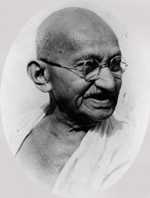
Mahatma Ghandi was a world changer.  He is the father of modern India.

In Mahatma Ghandi’s autobiography, he makes a statement that is crushing.

Ghandi went to Oxford University and encountered the teaching of Jesus for the first time.  He said he had found what he had searched for all his life in Jesus’ teaching.  On his way back to India, he stopped in North Africa for a few weeks.  It was there he encountered some so called Christians.  When he boarded the ship for India he had discarded the teachings of Jesus.

Ghandi: I like your Christ, I do not like your Christians

His statement was “I like your Christ, I do not like your Christians. I would have been a Christian, but for Christians.”

I do not want to just say I am a Christian, I want to be one!

Thanks for reading today!

« Previous PageNext Page »